Social Media Image Resizer – Instagram, YouTube, TikTok | TempScript
100% browser-based • Images never leave your device

Social Media Image Resizer

Crop and resize images for Instagram, YouTube, TikTok, LinkedIn and Facebook — all in your browser. Pick a preset, adjust the crop, and download as PNG, JPG or WebP. No uploads, no sign-up, no watermark.

Social media image resizer tool

Private by design. Your images are processed entirely in the browser using the HTML5 Canvas API. They are never uploaded, stored, or logged on any server.

Preview & crop No image loaded

Drop an image here

or click to browse your device

JPG, PNG, WebP, GIF — max ~20 MB
Drag the image to reposition it inside the crop area

Output size

×

1:1

Adjust crop

Scale 100%
Left / right 50%
Up / down 50%

Export

Source—
Output—
Est. size—
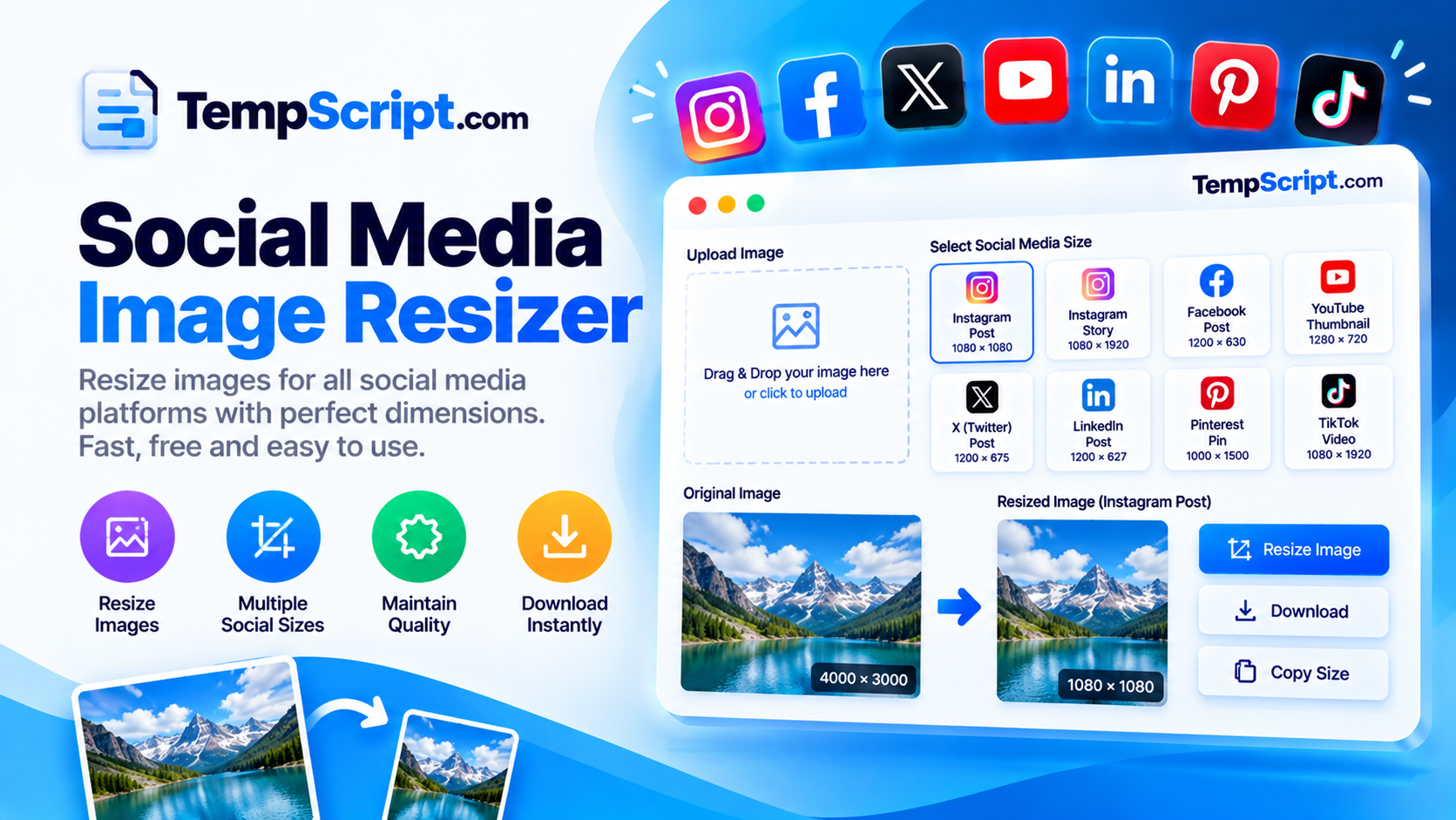
Social media image resizer with platform presets, a crop preview and export options
Upload an image, pick a preset, adjust the crop, and export as PNG, JPG or WebP.

How to use the social media image resizer

  1. Upload an image. Drag and drop a JPG, PNG, WebP or GIF, or click Choose image to browse your device.
  2. Pick a platform preset. Choose Instagram, YouTube, TikTok, LinkedIn or Facebook, then select the specific size you need.
  3. Fine-tune the crop. Drag the image inside the preview to reposition it, and use the Zoom slider to scale. The aspect ratio stays locked unless you unlock it.
  4. Choose a format. Pick PNG for lossless quality and transparency, JPG for smaller photographic files, or WebP for the best of both worlds.
  5. Download. Click Download image and the resized file saves to your device — no upload, no watermark.

Key features and benefits

Ready-made presets

Exact recommended sizes for Instagram posts, stories and reels; YouTube thumbnails and banners; TikTok videos; LinkedIn profiles, posts and banners; and Facebook covers and posts.

Precise crop controls

Zoom, drag and adjust position with sliders or by dragging directly on the preview. Lock or unlock the aspect ratio as needed.

PNG, JPG and WebP

Export as lossless PNG, compact JPG with adjustable quality, or modern WebP for the smallest file size.

Private by default

All processing happens in your browser via Canvas. Your images are never uploaded, stored, or logged anywhere.

Responsive layout

Canvas and controls sit side by side on desktop and stack vertically on mobile — comfortable on any screen.

Live preview & size

See exactly what will be exported, along with the estimated output file size, before you download.

Privacy and limitations

  • Fully client-side. Images are read, cropped, resized and encoded locally using the HTML5 Canvas API. Nothing is uploaded, stored, or logged.
  • No tracking of content. The tool does not record which images you load or what size you export. There is no analytics on image content.
  • No automatic saving. Images are held in memory only. Reloading the page clears everything.
  • Format support. JPG, PNG, WebP and GIF are accepted on input (GIF is treated as a static frame). Output is limited to PNG, JPG and WebP because those are what the browser can encode natively.
  • Large images. Very large source files (over ~6000 px on a side) may slow the browser because all work happens in memory. If that happens, resize the image first or use a smaller source.
  • Upscaling softens details. If the source image is smaller than the target preset, the resizer must upscale. Always start from the highest-resolution source you have.

Frequently asked questions

Is this image resizer free to use?
Yes. This tool is completely free, requires no account, and runs entirely in your browser.
Are my images uploaded to a server?
No. All cropping, resizing and export happen locally in your browser using the HTML5 Canvas API. Your images never leave your device.
What is the difference between PNG, JPG and WebP?
PNG is lossless and supports transparency, which is best for logos and graphics. JPG is smaller for photographs but does not support transparency. WebP offers good compression with transparency support and is widely supported by modern browsers and social platforms.
What size should I use for Instagram?
Instagram recommends 1080 × 1080 pixels for square posts, 1080 × 1350 for portrait posts, 1080 × 566 for landscape posts, and 1080 × 1920 for stories and reels.
Can I resize images for multiple platforms at once?
Yes. After cropping, you can switch presets and re-crop or export the same image at multiple sizes without re-uploading.
Why does the exported image look blurry?
If your source image is smaller than the target preset, the resizer has to upscale, which can soften details. Always start from the largest available source image for the best results.

A practical guide to social media image sizes

Every social platform has its own idea of the ideal image size, and getting it wrong has visible consequences: awkward crops in feeds, blurry thumbnails, or a banner that leaves large empty margins. A dedicated resizer that lets you crop and export for each platform is faster than reworking the same image five times in a general-purpose editor.

Recommended sizes at a glance

  • Instagram — 1080 × 1080 for square posts, 1080 × 1350 for portrait, 1080 × 566 for landscape, 1080 × 1920 for stories and reels, 320 × 320 for profile pictures.
  • YouTube — 1280 × 720 for thumbnails, 2560 × 1440 for channel banners (with a safe area of 1546 × 423 in the middle), 800 × 800 for channel icons.
  • TikTok — 1080 × 1920 for vertical video, 1080 × 1080 for square, 200 × 200 for profile pictures.
  • LinkedIn — 1200 × 627 for shared posts, 1584 × 396 for company banners, 400 × 400 for profile pictures, 1128 × 191 for personal banners.
  • Facebook — 1200 × 630 for shared links, 1080 × 1080 for square posts, 820 × 312 for page covers, 170 × 170 for profile pictures.

Choosing the right format

For photographs, JPG at high quality is a good default: small file, natural-looking gradients, and no transparency needed. For graphics, logos, screenshots or anything with sharp edges and flat colour, PNG gives you lossless quality and crisp text. WebP is the modern choice when you need both good compression and transparency — it is supported by every current browser and by all the major social platforms as an upload format.

Why cropping matters more than resizing

Resizing alone changes the dimensions of an image without changing its composition. Cropping changes what part of the image ends up in the final frame. A square Instagram post cut from a landscape photo will either include the whole width with large letterbox areas, or a tightly cropped section. Being able to drag the crop and see the result live is the difference between a picture that looks intentional and one that looks accidental.

Common mistakes to avoid

  • Uploading a source that is too small. If the source is smaller than the target, the resizer must upscale. Start from the largest version you have.
  • Using JPG for text-heavy images. JPG compression creates visible artifacts around sharp edges. Use PNG or WebP for graphics with text.
  • Forgetting the safe area on banners. Many platforms crop banners differently on desktop and mobile. Keep important content within the safe area shown in the platform's own guidance.
  • Over-compressing. A JPG at 60% quality saves space but can look noticeably worse. For most images, 80–92% is the sweet spot.

About this tool

This image resizer is part of the TempScript free online tools collection. It runs entirely in your browser, requires no account, and never sends your images anywhere. If you work with images and text regularly, you may also find our Base64 encoder and decoder and QR code generator useful for embedding assets and creating shareable links.

© 2026 TempScript. All rights reserved.