PDF Page Organizer – Reorder, Rotate, Delete Pages | TempScript
100% browser-based • Files stay on your device

PDF Page Organizer

Upload a PDF, then reorder, rotate, delete or extract pages with a visual thumbnail grid. When you are happy with the layout, download the result as a new PDF. Everything runs locally in your browser — no uploads, no sign-up, no watermark.

PDF page organizer tool

Private by design. PDFs are read and rewritten entirely in your browser using PDF.js and pdf-lib. Your files are never uploaded, stored, or logged on any server.

Drop a PDF here

or click to browse your device

Maximum size depends on your browser's memory. Files up to ~50 MB usually work well.

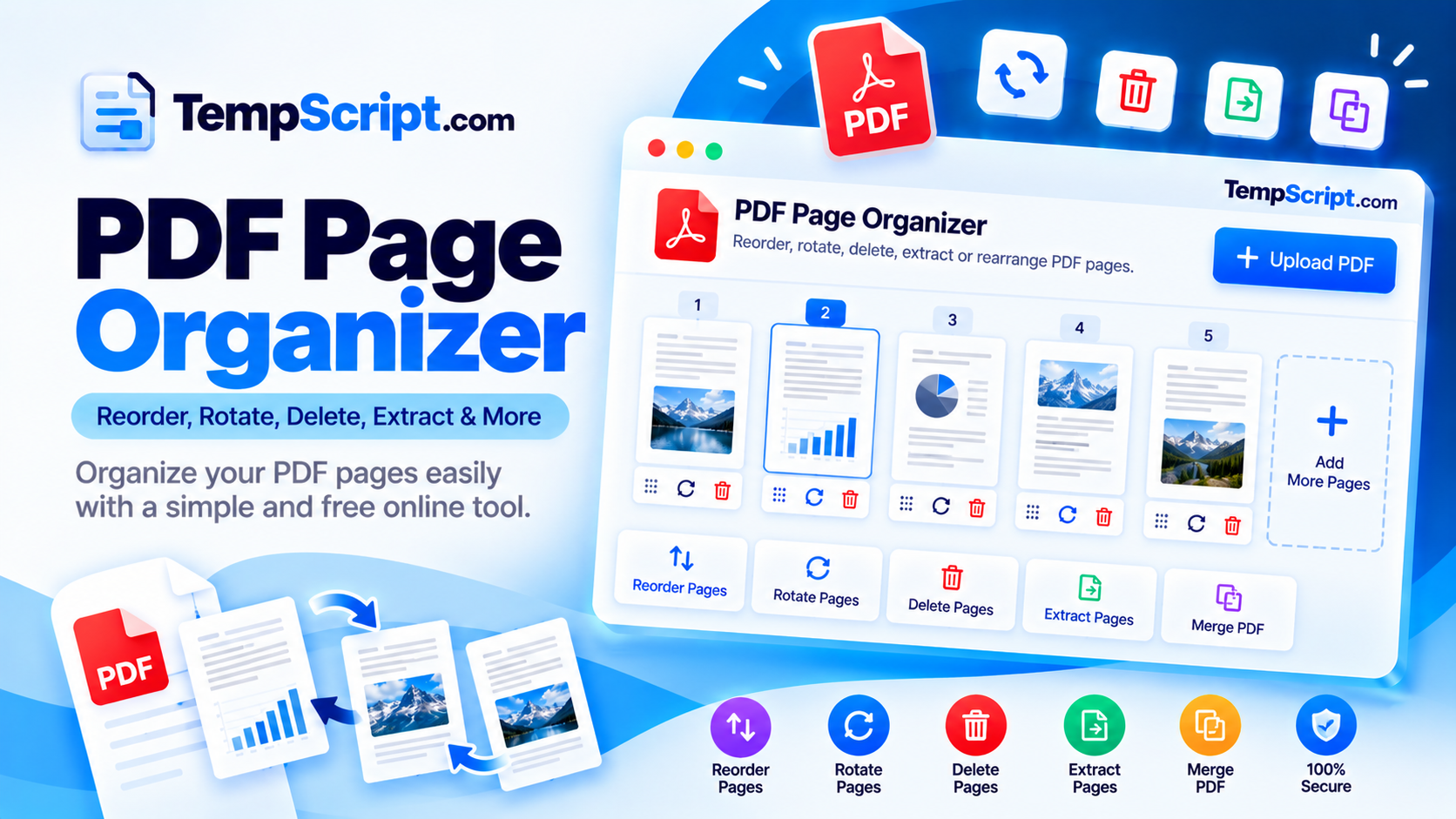
PDF page organizer with a grid of page thumbnails, rotation controls and a download button
Reorder, rotate, delete and extract PDF pages, then download the result.

How to use the PDF page organizer

  1. Upload a PDF. Drag and drop a file onto the drop zone, or click Choose PDF to browse your device.
  2. Reorder pages. Drag any thumbnail to a new position. A dashed outline shows where the page will land.
  3. Rotate or delete. Use the icons on each thumbnail to rotate a page 90° clockwise, or remove it from the current layout.
  4. Extract a subset. Tick the checkboxes on pages you want, then click Extract selected to download only those pages as a new PDF.
  5. Download the result. Click Download organized PDF to save your changes. The original file on your device is never modified.

Key features and benefits

Visual page thumbnails

Every page is rendered as a live thumbnail using PDF.js, so you always see exactly what you are working with.

Drag-and-drop reorder

Pick up any page and drop it into a new position. The grid reflows as you go, and nothing is committed until you download.

Rotate any page

Rotate individual pages or an entire selection by 90° increments. Rotation is applied without re-encoding, so quality is preserved.

Delete and extract

Remove pages you no longer need, or extract a subset into a separate PDF — perfect for splitting a report into chapters.

Private by default

All processing happens in your browser. Files are read from disk, held in memory, and written back as a download. Nothing is uploaded.

Responsive layout

Thumbnail grid adapts from a single column on small phones to a wide grid on desktop screens.

Privacy and limitations

  • Fully client-side. PDFs are parsed with PDF.js and rewritten with pdf-lib entirely inside your browser. No file content is ever transmitted to a server.
  • No tracking of content. The tool does not record which files you open or how you reorder them. There is no analytics on PDF content.
  • No automatic saving. Files are held in memory only. Reloading the page clears the current session.
  • Encrypted PDFs are not supported. If the file requires a password, the tool cannot open it. Please remove the password first.
  • Large files may be slow. Thumbnail rendering and re-saving are done in memory. Files over about 50 MB may be sluggish, and very large files can hit browser memory limits.
  • Original file is not modified. The downloaded PDF is a new file. Your source PDF on disk remains untouched unless you explicitly overwrite it.

Frequently asked questions

Are my PDF files uploaded to a server?
No. All processing happens locally in your browser using the PDF.js and pdf-lib JavaScript libraries. Your files never leave your device and are not uploaded, stored, or logged anywhere.
What happens when I rotate a page?
Rotation is applied by adding a rotation entry to the page in the output PDF. The original content is not modified, so no quality is lost. Rotations are stored in 90-degree increments.
Can I extract only some pages?
Yes. Select the pages you want with the checkboxes and click Extract selected to download a new PDF containing only those pages, in the order they appear in the current layout.
Does deleting a page remove it from the original file?
No. The original file is untouched. Deleting a page only removes it from the current editing session. Downloading produces a new PDF; the source on your device is unchanged.
Is there a size limit?
The tool works well with PDFs up to a few tens of megabytes. Very large files may be slow because all processing happens in memory. If the browser runs out of memory, try splitting the file first.
Why does my PDF look different after downloading?
The reordering and rotation are applied exactly as shown in the preview. Small visual differences in fonts or vector rendering can occur if the original PDF used embedded fonts that pdf-lib handles slightly differently. Standard text and images are preserved.

A practical guide to organizing PDF pages

PDFs are the universal format for sharing documents, but they are rarely produced in the exact order you need. A report might come back with the appendix first, a scanned bundle might have pages out of sequence, or a slide deck might need a last-minute reorder before a meeting. A dedicated PDF page organizer lets you fix the layout visually and produce a new file without touching a heavyweight desktop editor.

What you can do with a page organizer

  • Reorder pages. Drag thumbnails into the sequence you want. This is faster than extracting and merging single pages in separate tools.
  • Rotate pages. Scanned documents often come in sideways or upside-down. Rotating one page at a time preserves the rest of the layout.
  • Delete pages. Remove blank pages, separators or unwanted sections without affecting the source file.
  • Extract a subset. Pull out a chapter, a section or a single page into a new PDF to share separately.

Why browser-based is often better

Desktop tools are powerful but heavyweight, and online services often upload your file to a server. A browser-based tool that processes files locally combines the best of both worlds: the convenience of a website with the privacy of a desktop application. Modern browsers expose the same PDF rendering and writing capabilities that desktop tools use, and libraries like PDF.js and pdf-lib make them accessible from plain JavaScript.

What to watch out for

  • Encrypted PDFs. Files that require a password cannot be opened without it. Remove the password first.
  • Form fields and annotations. Some PDF editors preserve interactive forms; others flatten them. If the original file has fillable fields, check the output before submitting it.
  • Embedded fonts. Most modern PDFs embed the fonts they use. If a font is not embedded and is not available on the system that opens the file, text may look different.
  • Large scans. High-resolution scanned pages produce large files, and rendering hundreds of them can be slow. Splitting the file into smaller chunks first is often faster.

About this tool

This PDF page organizer is part of the TempScript free online tools collection. It runs entirely in your browser, requires no account, and never sends your files anywhere. If you work with documents and images regularly, you may also find our social media image resizer and Base64 encoder and decoder useful for preparing assets.

© 2026 TempScript. All rights reserved.